1. Core Concept
Complex Numbers expand the real number system to solve equations like
x2+1=0 by introducing i = √-1, bridging algebra
and 2D geometry (the Argand plane). Quadratic Equations deal with finding
roots of degree-2 polynomials. Linear Inequalities define ranges of valid
solutions.
2. Complex Numbers
- Algebraic Form:
z = a + ib. - Polar Form:
z = r(cos θ + i sin θ). - Modulus:
|z| = √(a2 + b2)(Distance from origin). - Conjugate:
z̅ = a - ib(Reflection across the Real x-axis). - Identity:
z · z̅ = |z|2.
Fundamental Theorem of Algebra (FTOA)
Statement: Every polynomial equation of degree n ≥ 1 with complex coefficients has at least one complex root.
Key Corollaries for IAT:
- Exactly n Roots: A polynomial of degree
nhas exactlyncomplex roots (counting multiplicities). - Conjugate Root Theorem: If the coefficients are real, complex roots must occur in conjugate pairs (
a ± ib). - Irrational Pair Theorem: If the coefficients are rational, irrational roots of the form
a ± √boccur in pairs.
3. Quadratic Equations
D = b2 - 4ac.Roots Relations:
- Sum of roots (α + β) = -b/a
- Product of roots (αβ) = c/a
- Difference of roots (|α - β|) = √D / |a|
Nature of Roots (for real coefficients):
- D > 0: Real & distinct.
- D = 0: Real & equal.
- D < 0: Complex conjugate pairs.
4. Linear Inequalities
Algebraic Solution Steps
To solve a linear inequality (e.g., ax + b < c):
- Simplify both sides by removing brackets and collecting like terms.
- Add or subtract the same number from both sides (inequality sign remains the same).
- Multiply or divide both sides by the same positive number.
- Golden Rule: If you multiply or divide by a negative number, you must reverse the inequality sign (
<becomes>).
Interval Notation
Solutions are expressed using the following intervals:
(a, b)→a < x < b(Open: endpoints excluded)[a, b]→a ≤ x ≤ b(Closed: endpoints included)[a, b)→a ≤ x < b(Semi-open)(−∞, a]→x ≤ a
Graphical Representation
Inequalities can be visualized on a number line as follows:
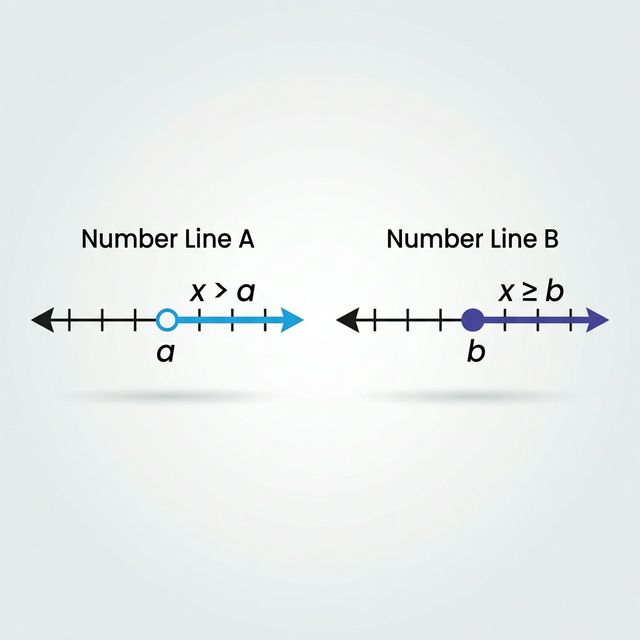
Comparing Open (x > a) vs. Closed (x ≥ b) endpoints.
- Open Circle (○): Used for
<or>(Endpoint not part of solution). - Closed Circle (●): Used for
≤or≥(Endpoint is part of solution).
Wavy Curve Method (Method of Intervals):
To solve rational inequalities like (x-1)(x-3) ≤ 0:
- Locate critical points (roots of numerator and denominator).
- Place them on a number line. The sign usually alternates across intervals.
- Pro Tip: Use open intervals
()for roots that come from the denominator, even for slack inequalities.
5. Conceptual Insights
- Geometry of i: Multiplying a complex number by
irotates its vector representation by 90° counter-clockwise. - Triangle Inequality:
||z1| - |z2|| ≤ |z1 ± z2| ≤ |z1| + |z2|. - Cross-Multiplication Trap: Never cross-multiply an inequality variable unless you are 100% sure it is strictly positive. Instead, bring everything to one side and use the Wavy Curve method.
5. Common Mistakes to Avoid
- Inequality Sign Reversal: Forgetting to reverse the sign when multiplying/dividing by a negative number.
- Conjugate Root Assumption: Assuming complex roots are always conjugates. This only applies if all coefficients are real.
- Triangle Inequality: Confusing the direction; remember
|z1 + z2| ≤ |z1| + |z2|. - Wavy Curve Errors: Not accounting for even multiplicities of roots (where sign does NOT change).
6. IAT Exam Focus Points
Cube Roots of Unity (1, ω, ω2):
Memorize identities: 1 + ω + ω2 = 0 and
ω3 = 1. If you see x2+x+1=0, the roots
are ω and ω2.
Locus in Argand Plane:
|z - z1| = |z - z2| describes the perpendicular
bisector of the line segment joining z1 and z2.
Complex Conjugates:
Complex roots always occur in conjugate pairs (p ± iq) only if the coefficients of the quadratic are real numbers.
7. Practice Mock Test
Ready to test your knowledge?
Take a quick 15-question assessment specifically designed for Complex Numbers, Quadratics & Inequalities. Challenge yourself with IAT-level questions.
Start Practice MockEnd of Chapter
Complex Numbers, Quadratics & Inequalities