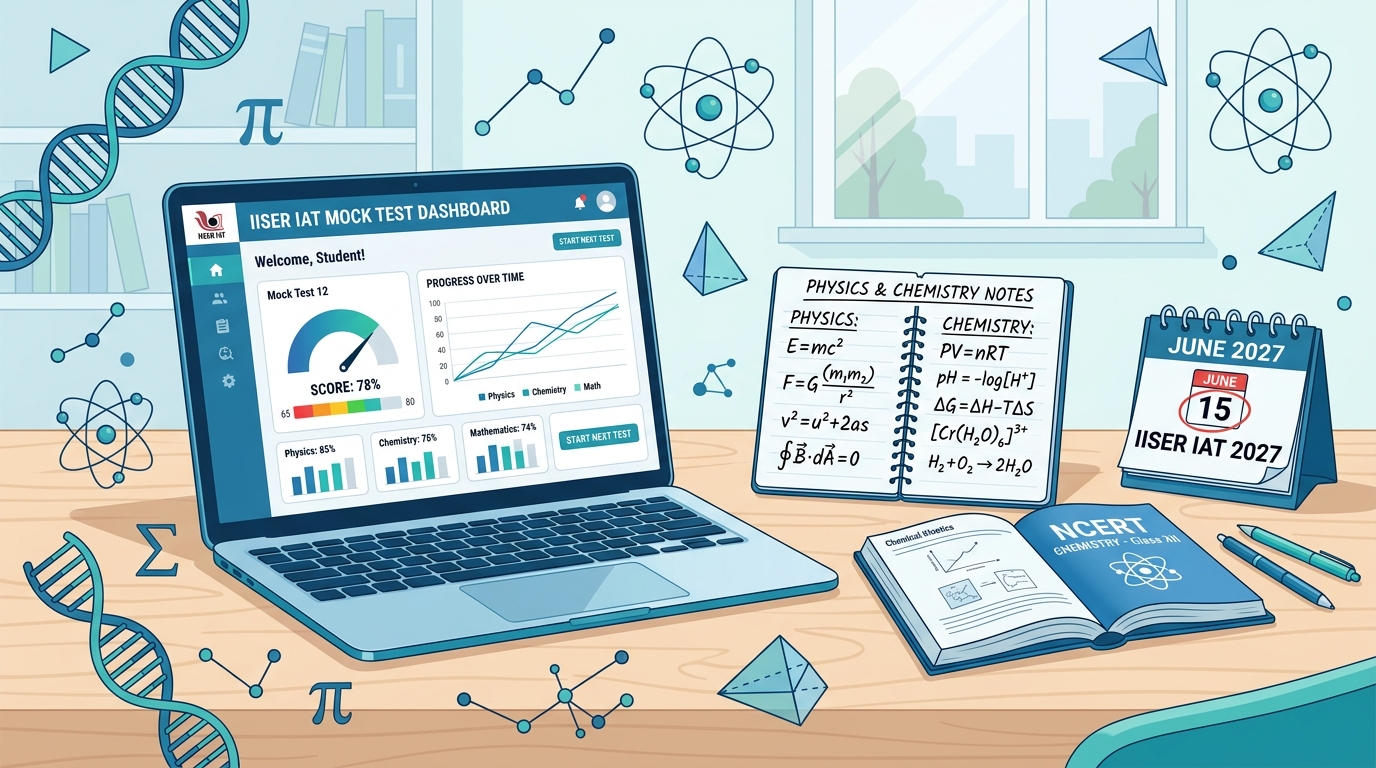
This confusion is normal. Most IAT aspirants feel it at some point. The problem isn't a lack of effort. It's a lack of direction. Preparing for IISER IAT isn't about sitting at your desk for twelve hours and hoping something sticks. It works better when you follow a clear loop: understand the concept, solve problems, attempt previous year questions, take mock tests, analyze what went wrong, and revise. Repeat.
This article is built around that loop. Every section below gives you something practical you can apply today, whether you are starting fresh or trying to fix gaps in your preparation.
What Is IISER IAT?
The Indian Institutes of Science Education and Research (IISERs) are among the best places in India to study pure and interdisciplinary science. Admission to the five-year BS-MS dual degree programme happens primarily through the IISER Aptitude Test (IAT).
The IAT tests your grasp of Physics, Chemistry, Mathematics, and Biology. The questions are designed to check how well you understand concepts rather than how much you have memorized. That is why preparation for this exam feels different from board exams. You need speed, accuracy, and the ability to think under pressure.
At the time of writing, specific details about IISER IAT 2027 — such as exact exam dates, the number of questions, or the precise marking scheme — have not been officially announced by the IISERs. What follows in this article is general preparation guidance based on the structure of past IAT exams. Always cross-check current information on the official IISER admissions portal when it becomes available.
Understand the IISER IAT 2027 Syllabus First
Before you make a timetable or buy a new book, spend time with the syllabus. Most students skip this step and regret it later. The IAT syllabus broadly aligns with the NCERT curriculum for Classes 11 and 12 across all four subjects, but the depth of questioning can vary.
Physics covers mechanics, electricity, magnetism, optics, and modern physics. Chemistry spans physical, organic, and inorganic topics. Mathematics includes algebra, calculus, coordinate geometry, and trigonometry. Biology deals with botany, zoology, genetics, ecology, and human physiology.
Once you have the syllabus in front of you, break every subject into topics and classify them honestly:
| Category | What It Means | Action |
|---|---|---|
| 🟢 Strong | You can solve most questions correctly | Maintain with periodic revision |
| 🟡 Needs Practice | You understand the concept but make errors | Increase problem-solving frequency |
| 🔴 Weak | You avoid these chapters or get most questions wrong | Prioritize concept building |
| ⚪ Not Started | You haven't studied this yet | Schedule it into your plan |
For example, a student might classify their Physics topics like this:
- 🟢 Strong: Kinematics, Laws of Motion
- 🟡 Needs Practice: Electromagnetic Induction, Ray Optics
- 🔴 Weak: Rotational Dynamics, Semiconductor Electronics
- ⚪ Not Started: Nuclear Physics (if not yet covered in school)
This honest mapping prevents you from wasting time on chapters you already know while ignoring the ones that actually pull your score down.
How to Start IISER IAT 2027 Preparation
Getting started is often the hardest part. Here is a step-by-step approach you can follow from day one:
Subject-Wise IISER IAT Preparation Strategy
Each subject demands a different approach. Copy-pasting the same study method across Physics, Chemistry, Mathematics, and Biology will leave gaps.
Physics in IAT is heavily numerical. Start every chapter by understanding the physical meaning of formulas, not just their mathematical form. Ask yourself: What does this equation actually describe?
Maintain a formula notebook, but don't just list equations. Write down the conditions under which each formula applies, the units involved, and one solved example. This prevents the common error of applying the right formula to the wrong situation.
For numerical practice, begin with standard textbook problems. Once comfortable, move to IAT-level questions. Time yourself. Many students can solve Physics problems correctly but take too long. In the actual exam, that costs marks.
Use PYQs to spot patterns. Some topics — like rotational mechanics, electrostatics, and modern physics — tend to appear frequently. If you consistently get thermodynamics questions wrong, treat it as a signal to revisit the fundamental laws rather than memorizing more formulas.
Chemistry has three distinct personalities: Physical, Organic, and Inorganic. You cannot prepare all three the same way.
Physical Chemistry is mathematical. Practice numericals from mole concept, thermodynamics, chemical kinetics, and electrochemistry. Understand the derivations, but focus more on applying formulas under exam conditions.
Organic Chemistry rewards understanding over memorization. Learn reaction mechanisms step by step. Don't try to memorize every named reaction initially. Instead, understand electron movement, attacking reagents, and leaving groups. Once the logic is clear, the reactions become easier to recall.
Inorganic Chemistry requires more retention. NCERT is your primary text here. Read chapters like Coordination Compounds, d- and f-Block Elements, and p-Block Elements carefully. Make comparison tables for properties, colors, and oxidation states. Active recall works better than passive re-reading.
Track your errors separately for each branch of Chemistry. A mistake in organic mechanisms needs a different fix than a mistake in chemical equilibrium calculations.
Mathematics in IAT tests both speed and depth. Concept clarity is non-negotiable. If your fundamentals in algebra or trigonometry are shaky, advanced topics like calculus will become painful.
Start with solved examples to understand the thought process. Then attempt unsolved problems without looking at solutions. If you get stuck for more than ten minutes, look at the solution — but only after genuine effort. Simply reading solutions gives a false sense of understanding.
Progress gradually. Begin with single-concept problems, then move to multi-concept questions. IAT often combines two or three topics in one problem. For instance, a question might mix coordinate geometry with vectors, or calculus with trigonometric identities.
Maintain an error log specifically for Mathematics. Categorize mistakes: algebraic slip, formula confusion, wrong approach, or time pressure. Over time, this log reveals your recurring patterns. If you keep making sign errors in integration, that is a fixable habit — but only if you notice it. Time management matters enormously. Learn to recognize when to move on and return later.
Biology is often the deciding factor in IAT because many students either ignore it or treat it as an afterthought. The subject carries equal weight, and NCERT forms the backbone.
Read NCERT Biology actively. Don't just underline sentences. After reading a paragraph, close the book and explain the concept in your own words. This forces actual understanding rather than passive recognition.
Diagrams and terminology carry marks. Practice drawing and labeling important diagrams — the nephron, the human heart, the flower, the cell cycle. Use correct scientific terms in your notes.
For Genetics and Biotechnology, focus on problem-solving. Pedigree analysis, genetic crosses, and DNA replication calculations appear regularly. These chapters look theoretical but have a strong logical structure.
Use active recall for factual portions. Instead of re-reading Ecology or Human Physiology multiple times, test yourself with questions. What are the differences between xylem and phloem? What happens during each phase of meiosis? Retrieval practice strengthens memory far better than repeated reading.
How to Use NCERT for IISER IAT Preparation
NCERT textbooks are the most reliable starting point for IAT preparation, especially for Chemistry and Biology. For Physics and Mathematics, NCERT builds the foundation, but you will need additional practice for the higher difficulty level of IAT questions.
Here is how to use NCERT effectively:
- Read actively. Ask questions while reading. Why does this happen? What would change if this condition were different? Can I derive this formula myself?
- Make short notes. After finishing a chapter, write a one-page summary in your own words. Include definitions, formulas, and important diagrams. These notes become invaluable during revision.
- Solve NCERT exercises. The intext and end-chapter questions test basic understanding. Don't skip them even if they seem easy. They ensure your fundamentals are solid.
- Combine with problem practice. Reading NCERT alone won't prepare you for the exam. Follow each chapter with targeted question banks or topic tests.
How to Use IISER IAT Previous Year Questions
Previous year questions (PYQs) are one of the most underused tools in IAT preparation. They are not just for testing yourself after you finish the syllabus. They are for learning how the exam thinks.
- First attempt: Solve the question under exam-like conditions. No hints, no looking at notes.
- Check the solution: Understand the correct approach fully.
- Identify the concept: Which topic does this question belong to? Which sub-topic?
- Record the mistake: Write down what went wrong in an error notebook.
- Reattempt later: After a week or two, try the same question again without looking at your previous work.
PYQs help you discover several things:
- Frequently tested concepts: Some topics appear almost every year.
- Question styles: IAT often frames familiar concepts in unfamiliar ways.
- Weak topics: If you consistently get Organic Chemistry PYQs wrong, that chapter needs urgent attention.
- Time-management problems: Do you spend five minutes on a one-mark question?
- Careless errors: Are you misreading questions or making calculation mistakes?
You can practice IISER IAT PYQs through dedicated collections that organize questions by subject and topic, making it easier to practice chapter-wise before moving to full papers.
How Mock Tests Can Improve IAT Preparation
Most students treat mock tests as score-generating machines. They take a test, look at the marks, feel good or bad, and move on. That approach wastes the real value of mocks.
A mock test is a diagnostic tool. It tells you where you are bleeding marks. Here is what you should analyze after every test:
| Aspect | What to Check |
|---|---|
| Accuracy | How many attempted questions were correct? |
| Time spent | Where did you lose the most time? |
| Questions skipped | Did you skip easy questions by mistake? |
| Silly mistakes | Calculation errors, misreading, wrong bubbling |
| Conceptual mistakes | You didn't know the concept or applied it wrong |
| Guessing | How many guesses worked? Are you guessing too much? |
| Weak chapters | Which topics had the most wrong answers? |
There is a big difference between taking a mock test and learning from a mock test. The first takes three hours. The second should take at least another hour of careful analysis.
If your accuracy in Mathematics is 40%, more mock tests won't fix that. You need targeted concept revision. If you are skipping Biology questions because you run out of time, you need to adjust your section strategy. Let the mock test guide your next week of study, not just your mood.
How to Identify Your Weak Topics
You cannot fix what you cannot see. Use a simple color-coded system to track your preparation status:
| Color | Meaning |
|---|---|
| 🟢 | Strong — can handle most questions |
| 🟡 | Needs Practice — concept okay, errors under pressure |
| 🔴 | Weak — frequent mistakes or conceptual gaps |
Update this map every week based on your mock tests, PYQ attempts, and practice sessions. Turn the results directly into your next week's study plan. If Rotational Dynamics is 🔴, it gets two hours in the coming week. If Genetics is 🟡, schedule one extra problem set.
This system prevents the common trap of studying what you already enjoy while avoiding what actually needs work.
IISER IAT 2027 Study Plan
Your study plan depends on how much time you have. Here are three realistic approaches:
📅 6-Month Preparation Plan
- Months 1–2: Cover the full syllabus at a conceptual level. Finish NCERT reading for all four subjects. Solve basic exercises. Classify every topic as strong, average, or weak.
- Months 3–4: Intensive problem-solving. Focus on weak and average topics. Start subject-wise PYQs. Begin short weekly revision cycles for strong topics so they don't fade.
- Months 5–6: Full-length mock tests every week. Deep analysis after each test. Repair weak areas based on mock feedback. Increase revision time. Reduce learning new advanced topics unless they are explicitly weak areas.
📅 3-Month Preparation Plan
- Month 1 — Build concepts + cover syllabus: Move quickly through theory. Don't get stuck on perfection. Cover all chapters at least once. Make short notes simultaneously.
- Month 2 — PYQs + intensive practice: Attempt previous year questions topic-wise. Identify the most frequently tested areas. Solve more problems in weak subjects. Take section-based mock tests.
- Month 3 — Mocks + revision + weak-area repair: Take full-length mock tests twice a week. Spend equal time analyzing them. Revise using your short notes. Focus on accuracy and time management. Sleep adequately.
📅 30-Day Revision Plan
If the exam is one month away, your goal shifts from learning new things to consolidating what you know.
- Week 1: Revise strong topics quickly. Attempt one full mock. Identify the top five weak areas.
- Week 2: Target those five weak areas with focused practice. Attempt another full mock. Review all errors.
- Week 3: Take two full mocks. Analyze deeply. Revise formulas, reactions, and diagrams daily.
- Week 4: Light revision only. Review your error notebook. Attempt one final mock early in the week. Sleep well. Avoid new resources entirely.
No plan can guarantee selection in a specific timeframe. What these plans do is maximize the value of the time you actually have.
How Many Hours Should You Study for IISER IAT?
There is no magic number. Some students focus well for five hours. Others need eight. What matters more than the count is what happens during those hours.
- For school-going students: Four to six productive hours on weekdays, with longer sessions on weekends, is realistic. Use school hours to your advantage — if your school covers IAT-relevant topics, pay extra attention there.
- For full-time preparers: Six to eight focused hours with proper breaks usually works better than ten distracted hours. Quality drops sharply after long stretches without rest.
- For students balancing boards and IAT: Split your day. Give mornings to board syllabus and evenings to IAT preparation, or vice versa. Don't abandon one for the other. Board concepts often reinforce IAT fundamentals, especially in Chemistry and Physics.
Consistency beats intensity. Studying six hours every day for three months beats studying twelve hours for two weeks and then burning out.
Sample Daily IISER IAT Study Routine
Here is a realistic weekday schedule for a student preparing full-time:
| Time | Activity |
|---|---|
| 7:00 – 8:00 AM | Wake up, breakfast, light review of yesterday's notes |
| 8:00 – 10:00 AM | Concept learning (new topic, one subject) |
| 10:00 – 10:30 AM | Break & refresh |
| 10:30 AM – 12:30 PM | Problem solving (same subject as morning) |
| 12:30 – 1:30 PM | Lunch + rest |
| 1:30 – 3:30 PM | Second subject — concept + problems |
| 3:30 – 4:00 PM | Break |
| 4:00 – 5:30 PM | PYQ practice (mixed topics) |
| 5:30 – 6:30 PM | Error review + note-making |
| 6:30 – 7:30 PM | Dinner + break |
| 7:30 – 8:30 PM | Revision of older topics |
| 8:30 – 9:30 PM | Light reading / Biology diagrams / formula revision |
| 9:30 PM onwards | Wind down, sleep |
Adjust this based on your energy levels. If you focus better in the evening, shift heavy subjects there. The key is protecting sleep. Cutting sleep to study more almost always backfires.
Common IISER IAT Preparation Mistakes
You waste time on irrelevant topics.
Students often avoid Biology if they are from a PCM background, or Mathematics if they are from PCB. IAT requires all four.
Video content feels productive but doesn't build exam skills.
Some students save PYQs for "after the syllabus is complete" and never reach that point.
A mock test without analysis is just a number.
Five books per subject create decision fatigue.
What you studied in January will be gone by March without revision.
Twelve-hour marathon sessions followed by two days of nothing destroy retention.
Attempting all questions with low accuracy hurts more than attempting fewer with high accuracy.
No plan works if you abandon it before giving it time.
How IISER SmartPrep Can Help With Your Preparation
Preparing for IAT involves many moving parts — syllabus coverage, question practice, mock tests, error tracking, and revision. Managing all of this with notebooks and spreadsheets is possible, but it takes time away from actual studying.
IISER SmartPrep is built to handle the organizational side of preparation so you can focus on learning.
🚀 IISER SmartPrep Engine Highlights
Designed specifically for IISER IAT aspirants to eliminate confusion and streamline preparation.
Evaluates your standing across Physics, Chemistry, Math & Bio to highlight exact weak spots.
Generates a dynamic study schedule telling you what to study, when, and how much time to spend.
Breaks concepts into bite-sized segments followed by immediate targeted practice questions.
30-minute topic tests to quickly evaluate your recall whenever you have free time.
Simulates the real exam environment with accurate timing and marking rules.
Organized by subject, chapter, and difficulty level for systematic PYQ solving.
Deep breakdown of accuracy, time management, and silly mistakes after every mock test.
Automated reminders to revisit weak chapters right before memory decay occurs.
These features connect directly to the problems discussed in this article: unclear weak areas, lack of direction, poor mock test analysis, and inconsistent revision. Used consistently, they can make your preparation more structured and less stressful.
Final 30-Day IISER IAT Strategy
The last month before the exam is not for new learning. It is for sharpening what you already know.
- Revise, don't discover. Stick to your short notes, formula sheets, and error notebook. Avoid starting a new reference book or a new chapter you haven't touched before.
- PYQs remain essential. Reattempt questions you got wrong earlier. If you get them right now, you have genuinely improved. If you still get them wrong, that topic needs one final focused session.
- Mock tests should be strategic. Take them at the same time of day as the actual exam if possible. Practice bubbling answers, managing rough work, and deciding when to skip a question. Simulate exam conditions.
- Your error notebook is your best friend. In the final week, read through every mistake you recorded. These are the specific gaps most likely to cost you marks.
- Repair weak topics selectively. You cannot fix everything in thirty days. Pick the top three to five weak areas that appear frequently in PYQs and give them targeted attention. Let go of obscure, rarely tested topics.
- Time management needs practice. Decide your section order before the exam. Some students prefer starting with their strongest subject to build confidence. Others start with their weakest when their mind is freshest. Test both approaches in mocks and pick what works.
- Sleep and consistency matter more than last-minute cramming. A well-rested brain performs calculations faster and makes fewer careless errors. Protect your sleep schedule, especially in the final week.
- Avoid unnecessary new resources. The internet will flood with "last-minute tips" and "predicted questions." Most of it is noise. Trust your preparation and your plan.
Frequently Asked Questions
Final Thoughts
IISER IAT preparation is a marathon, not a sprint. The students who perform well are usually not the ones who studied the most hours or solved the most books. They are the ones who studied with direction, analyzed their mistakes honestly, revised consistently, and stayed calm under pressure.
You don't need to be perfect in every subject. You need to be good enough across all four, excellent in at least one or two, and smart about managing your time and accuracy on exam day.
Start where you are. Use what you have. Do what you can. The rest follows.
Not sure where you currently stand in your IAT preparation? Use IISER SmartPrep's free assessment to understand your current readiness, identify areas that need more work, and get a clearer direction for your preparation.